What is a bit?
A bit (shortened from binary digit) is the smallest unit of information used in computers, defined as either a 0 or a 1. Bits are often stored together in 8’s, known as a byte. You’ve likely come across the concept of bytes before when dealing with phone or computer storage, often as gigabytes (GB). 1 GB is roughly 1,073,741,824 bytes!
So what is a qubit?
A qubit is a quantum bit. The main difference of note between a qubit and a bit is that where a bit can have a value of 0 or 1, a qubit can be 0, 1, or anything in-between! The concept of a qubit being multiple states at the same time is called coherent superposition. But it’s best not to picture a qubit as a linear scale between the two – it’s actually closer to a sphere… a Bloch sphere!

Understanding Bra Kets
Right now, that above diagram might seem extremely confusing for you – so lets observe and break it down! (wink)
Qubits and quantum probability as a whole are denoted using Dirac’s Notation – also known as “bra ket” notation. In the diagram you can see |0⟩ and |1⟩ which are respectively called “ket 0” and “ket 1”.
Whilst not shown in the diagram, you can also come across ⟨f| which is a bra. To summarise, left pointing is bra and right pointing is ket.
Fun fact: when bras and kets are used together, they look like pointed brackets, which is where they got their name from!
Qubit’s Values
Until measured, the value of a qubit is technically unknown. This is because quantum particles break down under observation and lose their quantum properties – but we will get back to this later! Until this observation occurs, we can only get a probability of the outcome of the particle, which is a nicer way of saying we will have a little guess. The notation of this looks like:

Where ψ is a single qubit (‘s outcome), and α and β are probability amplitudes (will be covered in the second paragraph down) for the outcome of 0 or 1. Put simply, a qubit’s outcome is decided on how likely it is to be 0 or 1.
In the diagram shown above however, you can see two angle values. As mentioned previously, the value between 0 and 1 isn’t on a linear scale but a sphere. This means that to find where a value might fall on a bloch sphere, we need to think about angles. Remember learning angle theorem as a child? Yeah, unfortunately the teachers were right, you will need it later in life (a.k.a right now!)
So we mentioned the probability amplitudes, α and β. These sound technical, but actually are the values:
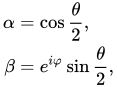
where θ and φ are those angles seen in the diagram. e^iφ is more than just an angle however, its the relative phase!
See, it all comes together! So lets summarise:
Summary
Qubits are quantum bits. Rather than being 0 or 1, they can be values in-between, therefore being multiple states at one in coherent superposition. This value in-between is notated using Dirac’s Notation, and is essentially the probability a qubit will more likely end up 0 or 1 once measured/observed. This value can be drawn on a sphere which is called a Bloch sphere. When a qubit is observed, it absolutely must end up as 0 or 1 as it loses all quantum properties, hence becoming a regular bit again!
If you still have questions, don’t hesitate to ask! There is no shame in not understanding quantum – even the professionals don’t really know what is happening!

Leave a comment